
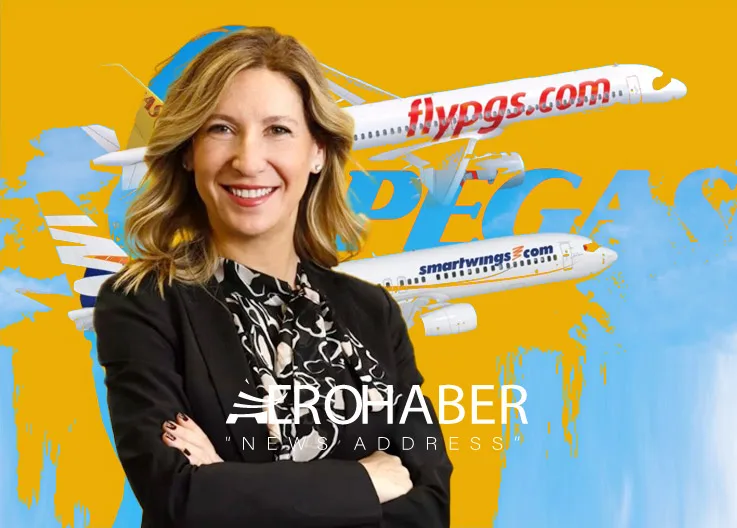


Pegasus Airlines CEO Güliz Öztürk stated that one of the most critical agenda items for 2026 will be the initiation of the integration process of the Smartwings Group acquisition following official approvals, adding that this step will form the foundation of the company’s international growth objectives.
Pegasus Airlines is preparing to complete 2025 with a strong growth momentum, supported by its stable performance in domestic and international operations. The company maintained its position in the sector through rising passenger demand, high load factors and a focus on operational efficiency.
Pegasus Airlines Chief Executive Officer (CEO) Güliz Öztürk, speaking to an made important statements regarding the company’s 2025 activities and its 2026 targets. Öztürk noted that approximately 40 million passengers were carried during the January–November period, representing a 15 per cent increase compared to the same period last year.
Stating that 1.7 million more passengers were carried in the third quarter compared to last year, and 5.3 million more during the January–November period, Öztürk said, “Despite increasing our capacity, we maintained a high load factor of 87.7 per cent. This picture clearly demonstrates the success of our efficiency-focused business model.”
Europe Became the Driving Force of International Growth
Emphasising that Europe-based routes were the main driving force behind growth in international operations, Öztürk stated that Germany ranked first with 3.2 million passengers, followed by the UK and Italy. Among destinations outside Europe, Russia stood out with 900,000 passengers.
Öztürk noted that London, Düsseldorf, Cologne and Vienna were among the busiest international routes, while Tbilisi and Moscow attracted attention on non-European flights.
Stating that steady growth also continued on domestic routes, Öztürk said, “Key connections between major cities, particularly Istanbul, saw strong demand throughout the year. As of today, we operate flights to 39 domestic destinations. As of November, we recorded 10.4 per cent growth on domestic routes.”

Demand-Oriented Network Management
Öztürk stated that among the main strategies supporting passenger growth were demand-oriented flight network management and directing capacity to the right routes, adding that newly launched international routes not only created direct demand but also contributed to feeding the existing network.
She noted that flexible schedules, increased frequencies and tourism-oriented additional flights were among the main factors supporting growth on domestic routes.
Emphasis on Digitalisation and a Young Fleet
Recalling that Pegasus has one of the world’s youngest fleets with an average age of 4.9 years, Öztürk stated that new-generation aircraft make a significant contribution to on-time departure performance and operational continuity. She added that investments in digitalisation and artificial intelligence increase efficiency across many areas, from flight planning to maintenance processes.
Smartwings Integration at the Core of 2026
Assessing the targets for 2026, Öztürk said that eight A321neo aircraft would be added to the fleet in the new year, and that the flight network would be expanded across Europe, the Middle East, North Africa and Central Asia.
Emphasising that the integration process of the Smartwings Group acquisition will be one of the most important agenda items of 2026, Öztürk said, “This step is the most concrete indicator of our vision for growth on an international scale. It will enable us to offer our guests a much broader flight network.”
Öztürk added that despite increasing cost pressures, Pegasus aims to build a future-ready, resilient and innovative airline through controlled capacity management, digitalisation, operational efficiency and sustainability-focused strategies.