
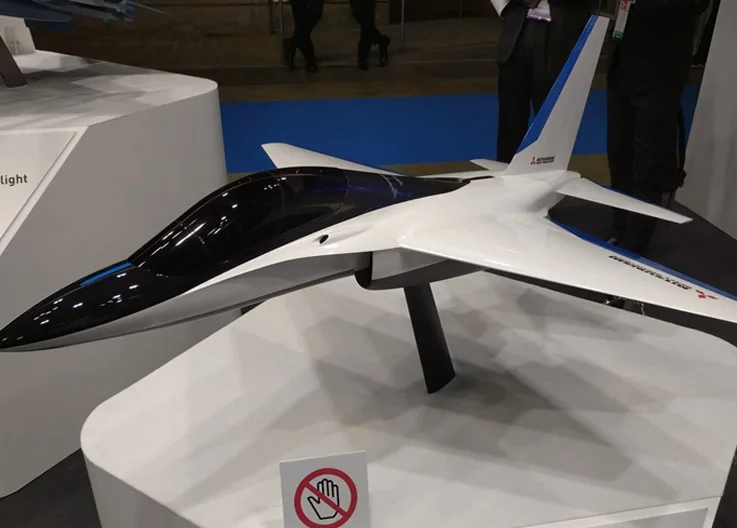


Mitsubishi Heavy Industries (MHI), one of Japan’s leading defence and aerospace companies, publicly revealed the conceptual design of its next-generation trainer aircraft, the TX, for the first time at the DSEI Japan 2025 defence exhibition. The aircraft is set to train the fighter pilots of the future.
The TX is being developed to replace the Kawasaki T-4 currently in service with the Japan Air Self-Defense Force (JASDF). Designed entirely with domestic resources, the TX reflects Japan’s goals of self-reliance and modernisation in its defence industry. With its twin-engine configuration, the aircraft stands in the same class as platforms like Türkiye’s HÜRJET, South Korea’s T-50, Italy’s M-346, and the US-made Red Hawk.
Regional Threats Drive the Need for Modern Training Platforms
The TX project has emerged as a response to Japan’s growing regional security concerns. China’s expanding air power and North Korea’s continued missile tests have highlighted the urgent need for next-generation training systems compatible with fifth- and sixth-generation fighter jets. In October 2024, Japan’s Acquisition, Technology & Logistics Agency (ATLA) issued a call for proposals for platforms to replace the current T-4 fleet. MHI’s TX was the first concrete design submitted in response.
Advanced Technology, Domestic Design
The TX concept unveiled by Mitsubishi Heavy Industries is a two-seat, twin-engine, fixed-wing jet trainer. MHI aims for the aircraft to cruise at a minimum speed of Mach 0.8. Featuring advanced avionics, a digital infrastructure compatible with simulators, and modular mission packages, the TX is designed to support both basic and advanced pilot training.
Thanks to these capabilities, the TX will play a critical role in preparing Japanese pilots to operate aircraft like the F-35A and the future sixth-generation FX fighter jets.
A New Standard in Japanese Engineering
The design of the TX builds on MHI’s past engineering experience with the T-2 and Kawasaki T-4 programmes. The decision to retain a twin-engine layout ensures safe flight performance at high altitudes and in challenging geographic conditions. Given Japan’s mountainous terrain and surrounding seas, this configuration offers vital operational redundancy.
A Domestic Alternative Competing on a Global Scale
While the TX offers comparable features to globally recognised platforms like the T-50 Golden Eagle and M-346 Master, it stands out by being tailored to Japan’s specific requirements. MHI’s concept is seen as a long-term, sustainable training solution for the JASDF.
The TX displayed at the exhibition featured white, black, and blue colours, reflecting MHI’s “cosmic design” philosophy. This aesthetic represents the forward-looking vision of Japanese engineering and the growing emphasis on domestic production capacity in the defence industry.
© AeroHaber.com / Mevlüt Zor – mevlutzorr@gmail.com