
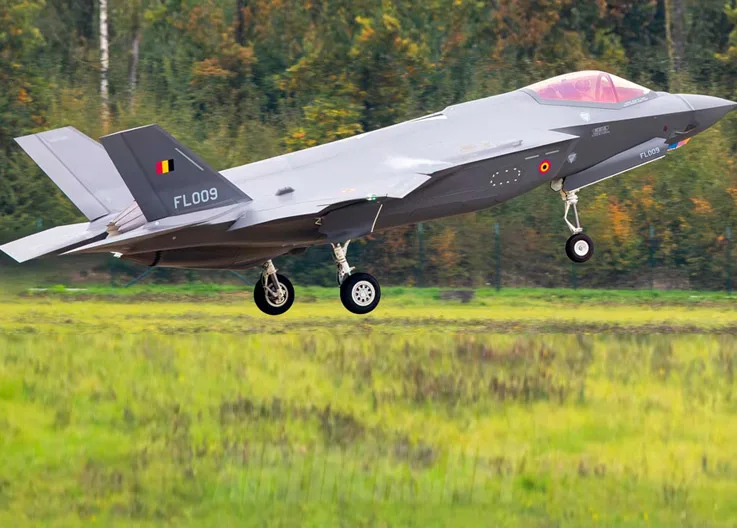


Belgium is facing training issues with its newly acquired F-35 fighter jets. Defence Minister Theo Francken announced that due to the country’s limited airspace, pilot training will be conducted in allied countries such as the Netherlands, Italy, and Norway.
Belgium’s F-35 fighter jets, ordered seven years ago and delivered in recent weeks, cannot be used at full capacity due to the narrowness of the country’s airspace. According to national media reports, it was determined that Belgium’s airspace is not wide enough to accommodate training flights for next-generation fighter jets.
Airspace Inadequate for F-35 Training
Defence Minister Theo Francken stated that discussions are ongoing with NATO allies such as the Netherlands, Italy, and Norway to enable Belgian pilots to receive training.
Francken explained that the F-35s’ high manoeuvrability and advanced radar systems make it difficult to test them safely within the current airspace boundaries.
Similar Problems Experienced During the F-16 Era
It was recalled that similar difficulties had been encountered in the past during F-16 training flights in Belgium. The country’s limited airspace has proven insufficient to meet the training needs of modern jets that require long-range and high-speed flights.
Belgium, which is in the process of renewing its F-16 fleet that has been in service since the 1980s, currently operates 45 F-16s. The Brussels administration had pledged to transfer 30 of these aircraft to Ukraine starting in 2026.
US-Made F-35 Choice Sparked Diplomatic Tensions
Belgium decided to continue its defence modernisation in cooperation with Washington by opting for US-made F-35 fighter jets instead of European-made alternatives. However, this decision caused unease in Paris, which had expected Belgium to choose the French-made Rafale jets.
Following the decision, a brief diplomatic tension arose between the two countries, and Brussels’ defence choices became a topic of debate within Europe.